Ranking up in competitive games is something every player wants—but very few actually understand how to do it consistently.
Most players believe ranking up is about playing more matches or getting lucky teammates. But in reality, climbing ranks is a combination of smart decision-making, consistency, and understanding how the ranking system works.
In 2026, competitive games are more structured and skill-based than ever. That means random play rarely leads to long-term progress.
This guide breaks down practical strategies that actually help you rank up faster and more consistently.
Why Most Players Stay Stuck in the Same Rank
Before improving, it’s important to understand why progress stops.
Most players get stuck because of:
- inconsistent gameplay
- poor decision-making under pressure
- focusing only on kills instead of objectives
- emotional or tilted gameplay
- lack of strategy and structure
The problem is rarely mechanical skill alone. It’s usually habits.
Once you fix habits, ranking becomes much easier.
1. Play With a Clear Objective Every Match
Many players enter ranked matches without a plan. They just “play and see what happens.”
But high-ranked players always have intent.
Before each match, you should ask:
- Am I playing aggressive or safe?
- Am I focusing on objectives or kills?
- What is my role in this match?
Having a clear mindset improves decision-making and reduces random mistakes.
Without a plan, you react. With a plan, you control.
2. Focus on Consistency, Not Highlight Plays
A common mistake is trying to make flashy plays in every match.
But ranked progression is not about highlights—it’s about consistency.
Instead of asking:
👉 “How can I get the most kills?”
Ask:
👉 “How can I avoid unnecessary deaths?”
Avoiding mistakes is often more valuable than making big plays.
Consistent performance leads to steady rank improvement.
3. Understand Your Role in the Team
In team-based games, every player has a role—even if it’s not officially labeled.
Common roles include:
- entry fragger / attacker
- support player
- defender / anchor
- strategist or controller
The problem starts when everyone tries to do everything.
Better results come when each player:
- understands their responsibility
- sticks to their role
- supports team structure
Winning teams are organized, not random.
4. Don’t Take Every Fight
One of the biggest mistakes in ranked games is fighting unnecessarily.
Not every enemy needs to be engaged.
Smart players consider:
- positioning advantage
- health and resources
- team support availability
- escape routes
Sometimes the best decision is to avoid a fight completely.
Ranking up is about survival and efficiency—not constant aggression.
5. Improve Map Awareness
Map awareness is one of the strongest ranking tools.
Good players always know:
- where enemies are likely to appear
- safe rotation paths
- high-risk zones
- common ambush locations
This helps you:
- avoid surprises
- position better
- make smarter rotations
Most low-ranked players ignore the map—and pay the price for it.
6. Play With Your Team Instead of Against Them
Solo behavior in team games often leads to losses.
Common mistakes include:
- rushing alone
- ignoring teammates’ position
- refusing to support pushes
Instead, focus on:
- staying close to your team
- coordinating attacks
- sharing information
Even average coordination beats strong individual play most of the time.
7. Learn When to Push and When to Hold
Timing is everything in ranked matches.
Bad timing includes:
- pushing too early without backup
- delaying too long and missing opportunities
Good timing means:
- attacking together as a team
- holding positions when needed
- waiting for the right moment
Smart timing often wins fights before they even begin.
8. Control Your Emotions During Matches
Emotional gameplay is one of the fastest ways to lose rank.
After a bad round, players often:
- rush aggressively
- make reckless decisions
- stop thinking clearly
This is called “tilt,” and it destroys consistency.
To avoid it:
- take short breaks after losses
- reset mentally before next match
- focus on decisions, not emotions
Calm players rank up faster than emotional ones.
9. Learn From Every Loss
Most players ignore their mistakes and immediately queue for the next match.
But improvement comes from reflection.
After each match, ask:
- Why did I lose that fight?
- Was my positioning correct?
- Did I communicate properly?
Even small insights help prevent repeated mistakes.
Losses are not failure—they are feedback.
10. Avoid Playing Too Many Matches in One Session
Long gaming sessions reduce performance over time.
After a few matches:
- focus decreases
- reaction time slows
- decision-making becomes inconsistent
Instead of grinding endlessly:
- play in short focused sessions
- take breaks regularly
- stop when performance drops
Quality gameplay is better than quantity.
Common Mistakes That Stop Rank Progress
Many players stay stuck because of simple habits:
- chasing kills instead of playing objectives
- ignoring teamwork
- playing while tilted
- inconsistent practice
- not analyzing mistakes
Fixing even a few of these can improve ranking speed significantly.
How Fast Can You Rank Up?
There is no fixed timeline, but generally:
- 1–2 weeks: improved awareness and consistency
- 3–6 weeks: noticeable rank improvement
- 2+ months: stable progression in higher ranks
Progress depends on consistency, not luck.
Final Thoughts
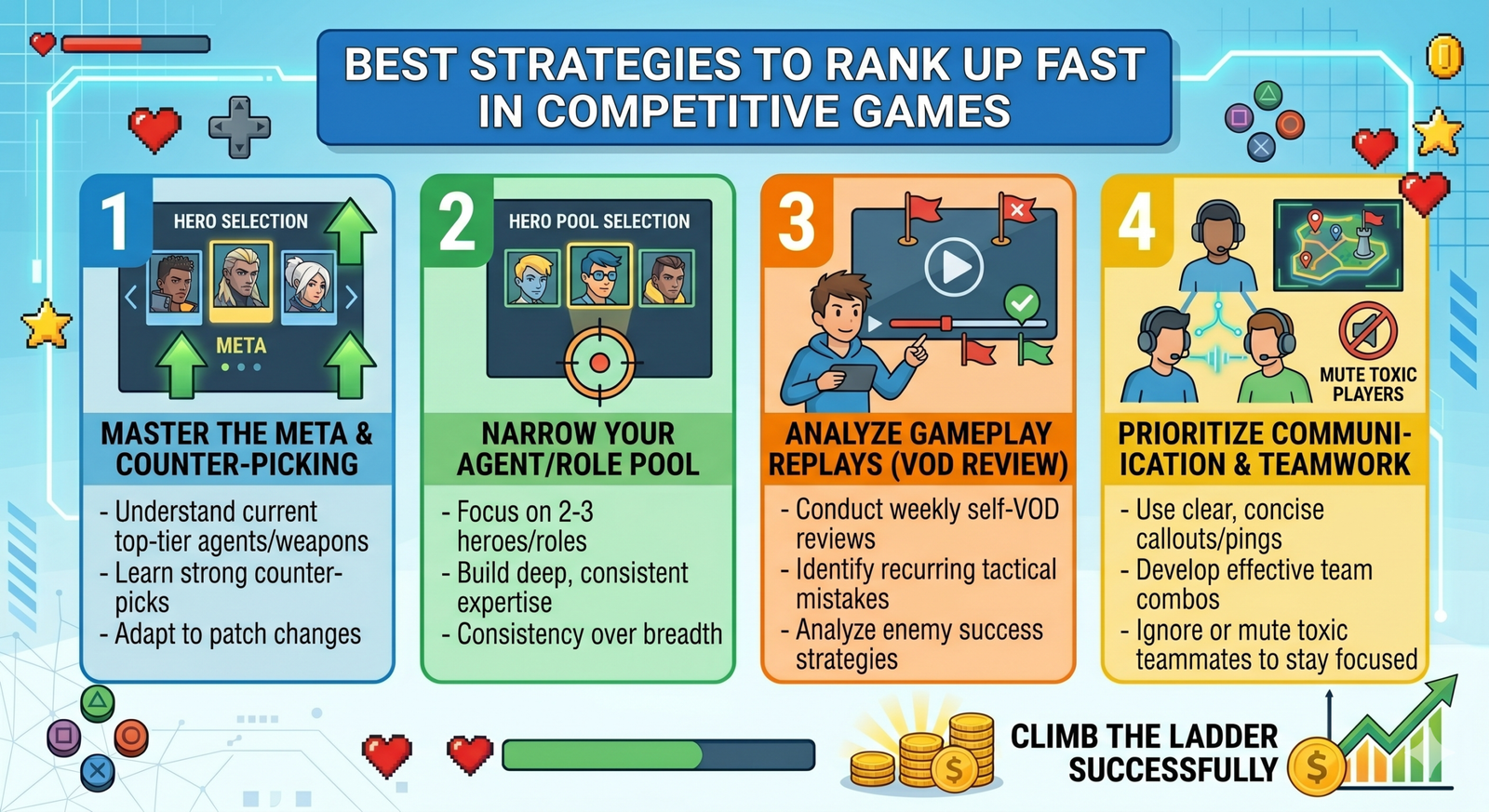
Ranking up in competitive games is not about playing more—it’s about playing smarter.
When you focus on:
- consistency
- teamwork
- decision-making
- emotional control
- awareness
your performance naturally improves.
Most players don’t stay stuck because they lack skill—they stay stuck because they repeat the same mistakes.
Once you fix your habits, rank progression becomes a natural result of better gameplay.
Because in competitive gaming, the players who rank up fastest are not always the most aggressive.
They are the most disciplined, aware, and consistent.